Say you are trying to peel your boots off after eight hours above treeline, and the laces have frozen into stiff little wires. Your feet are damp, not from the trail but from your own sweat trapped against snow-chilled leather. The insoles are cold enough to feel like standing on frozen tile. Nothing failed catastrophically — no sole came unglued, no seam ripped open — but the whole system quietly stopped working somewhere around hour four, and you spent the descent managing cold feet instead of enjoying the summit.
Winter boot care is a different discipline from three-season maintenance. The threats are not mud and UV degradation; they are refreeze cycles, road salt, and moisture that has nowhere to evaporate to in sub-freezing air. Below is a ranked list of the five maintenance priorities that make the biggest difference in snow conditions, based on several winters of testing gear from the Cascades to the White Mountains. They are ordered by how often they cause real problems on the trail, not by how satisfying they are to do.
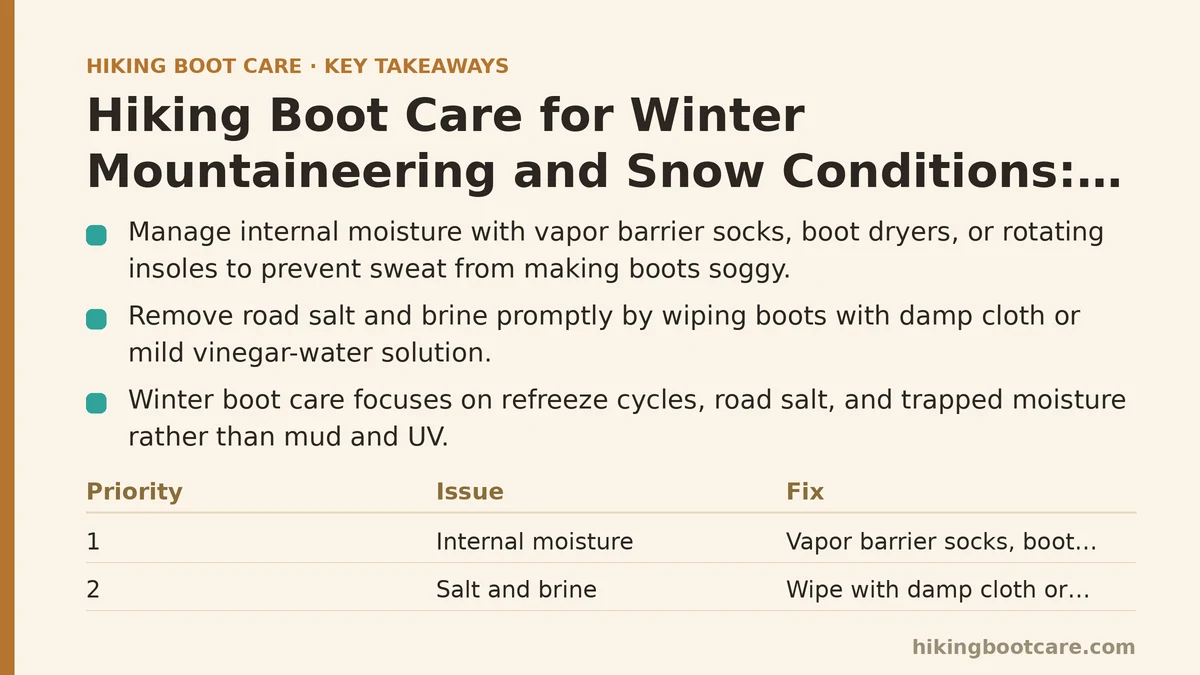
1. Managing Internal Moisture (The One That Ends Trips Early)
This ranks first because it is the failure mode that actually gets people off the mountain early, not the one that just annoys them.
In summer, sweat evaporates through the membrane and the DWR-treated exterior. In winter, cold outside air slows that vapor transfer dramatically. Your boots can be perfectly waterproof from the outside and still end the day soggy on the inside, because moisture generated by your own foot has nowhere to go.
What works:
- Vapor barrier socks or liners. A thin waterproof liner sock worn under your insulating sock keeps sweat off the insulation layer entirely. It feels strange for the first hour; by hour six, your feet are noticeably warmer and drier than a hiking partner without one.
- Boot dryers between days on multi-day trips. A low-heat electric boot dryer overnight removes moisture that a warm tent or lodge simply cannot pull out on its own. Stuffing boots with newspaper is a reasonable backup, but it is slower and less complete.
- Rotating insoles. Carrying a second, dry set of insoles and swapping them at lunch on long days keeps the coldest point of contact — the sole of your foot — away from accumulated moisture for the second half of the hike.
None of this requires special products beyond what most winter hikers already own. It requires a habit change: treating moisture management as a mid-hike task, not just an end-of-day one.
2. Salt and Brine Removal (The Silent Leather Killer)
If you drive to trailheads on treated roads, or hike anywhere near plowed parking areas, your boots pick up road salt and calcium chloride brine on the outsole and lower upper. This ranks second because the damage it causes is slow and easy to miss until a boot is already compromised.
Salt is hygroscopic — it pulls moisture out of leather rather than letting it stay hydrated, and repeated exposure leaves leather stiff, cracked, and prone to losing its shape around the flex points. On synthetic boots, dried salt crystals work their way into stitching and abrade the thread over a season of exposure.
The fix is simple but needs to happen promptly:
Wipe boots down with a cloth dampened in plain lukewarm water as soon as you get home, focusing on the rand, the lower quarter panels, and anywhere white residue is visible. A mild vinegar-water solution (one part white vinegar to four parts water) dissolves stubborn salt deposits without the harshness of soap. Let the boots dry away from direct heat, then follow with conditioner on leather boots — salt exposure accelerates the need for reconditioning, so a boot that normally needs oiling twice a season might need it three or four times if you are hiking icy trailhead roads all winter.
Skipping this step is the single fastest way to turn a $250 leather boot into a cracked, brittle one by February.
3. Insulation and Gaiter Compatibility (Where Fit Actually Changes)
Ranking third, but only barely behind salt damage in terms of long-term consequences: winter often means thicker socks, sometimes an added liner, and almost always integrated or strap-on gaiters. None of that is boot maintenance in the traditional sense, but ignoring it causes real damage.
Cramming a thicker winter sock into a boot fitted for three-season socks compresses circulation and increases pressure on the upper material at exactly the points — the forefoot, the ankle flex — where seams and rand adhesive are already under the most stress. Gaiter straps, run too tight and too low, can wear a visible groove into the leather of a boot after a single season of repeated use.
Check gaiter strap position at the start of the season. It should sit in the welt groove (where the sole meets the upper) rather than pressing directly against smooth leather or fabric. If you size up your socks for winter, confirm your boots still have enough room in the toe box; a boot that is too tight not only restricts blood flow and invites cold feet, it also puts your insoles and lining under abnormal compression that shortens their working life.
4. Traction Hardware Care (Crampons and Microspikes Damage Boots You Don’t Expect)
This one surprises people, which is why it sits at four rather than higher — the damage is real but slower to show up than moisture or salt problems.
Strap-on crampons and microspikes are hard on a boot’s rand and welt if they are not fitted correctly or removed carefully. Metal points dragged across a rubber rand during removal scuff and eventually cut into it. Straps left cinched too tight for a full day compress the rand adhesive bond in the same spot repeatedly, and over a season that can start the same delamination problems described in early-season inspection checklists.
Three habits prevent most of this damage:
- Size and fit crampons at home before the trip, not at the trailhead in the cold, so you are not forcing an ill-fitting binding onto the boot.
- Remove traction devices by loosening straps fully rather than yanking them off over the toe or heel.
- Inspect the rand for scuff marks or lifted edges every few outings during heavy crampon use, and address any lifting immediately with a flexible adhesive like Seam Grip before it spreads.
Boots rated for semi-rigid or rigid crampons (typically anything with a welt designed for a step-in binding) tolerate this far better than a softer three-season boot pressed into winter mountaineering duty. If you are using crampons regularly, the boot itself matters as much as the care routine.
5. Storage Between Winter Outings (Low Priority, But Not Zero)
Last on this list, but worth doing correctly: how you store boots between winter trips affects the previous four points. A boot stored wet in a cold garage refreezes any trapped moisture, which can slightly expand and stress seams over a season of repeated cycles. It is a slow, cumulative problem rather than an urgent one, which is why it ranks fifth.
Dry boots fully at room temperature before storing them. Loosen laces fully and pull the tongue forward so the interior gets full air exposure. Avoid drying racks directly above a wood stove or forced-air heater vent — the direct, sustained heat cracks leather and can degrade the glue bonds in the sole faster than any single hike would.
Comparing the Five Priorities
| Priority | Failure Speed | Typical Cost of Neglect | Effort to Address |
|---|---|---|---|
| 1. Moisture management | Same day | Cold feet, cut trip short | Low — habit change, minor gear |
| 2. Salt/brine removal | Weeks to months | Cracked, brittle leather | Low — 10 minutes after each trip |
| 3. Insulation/gaiter fit | Weeks | Circulation issues, rand wear | Low — one-time fit check |
| 4. Traction hardware care | Months to a season | Rand scuffing, delamination | Medium — requires attention each use |
| 5. Storage habits | A season or more | Cumulative seam/adhesive stress | Low — passive, just do it right |
Where This Leaves You
None of these five items require exotic products. A boot dryer, some vinegar, a properly fitted gaiter strap, and a habit of checking your rand after crampon use will handle nearly everything winter throws at your boots. What changes in winter is not the toolkit — it is the order of operations. Moisture management stops being optional maintenance and becomes something you think about mid-hike, and salt becomes a threat that did not exist on your summer trails at all.
Which of these five is most relevant to your setup probably depends on your terrain — road-salt exposure matters little if you are skinning in from a trailhead with no winter road maintenance, while moisture management matters everywhere cold air meets a working foot. Start with whichever one maps onto your actual failure last winter, and work down the list from there.
Related guides: How to Remove Salt Stains from Hiking Boots, Hiking Boot Care Tips for Complete Beginners: The 5 That Matter Most, and Common Hiking Boot Care Mistakes to Avoid (According to What Actually Fails).