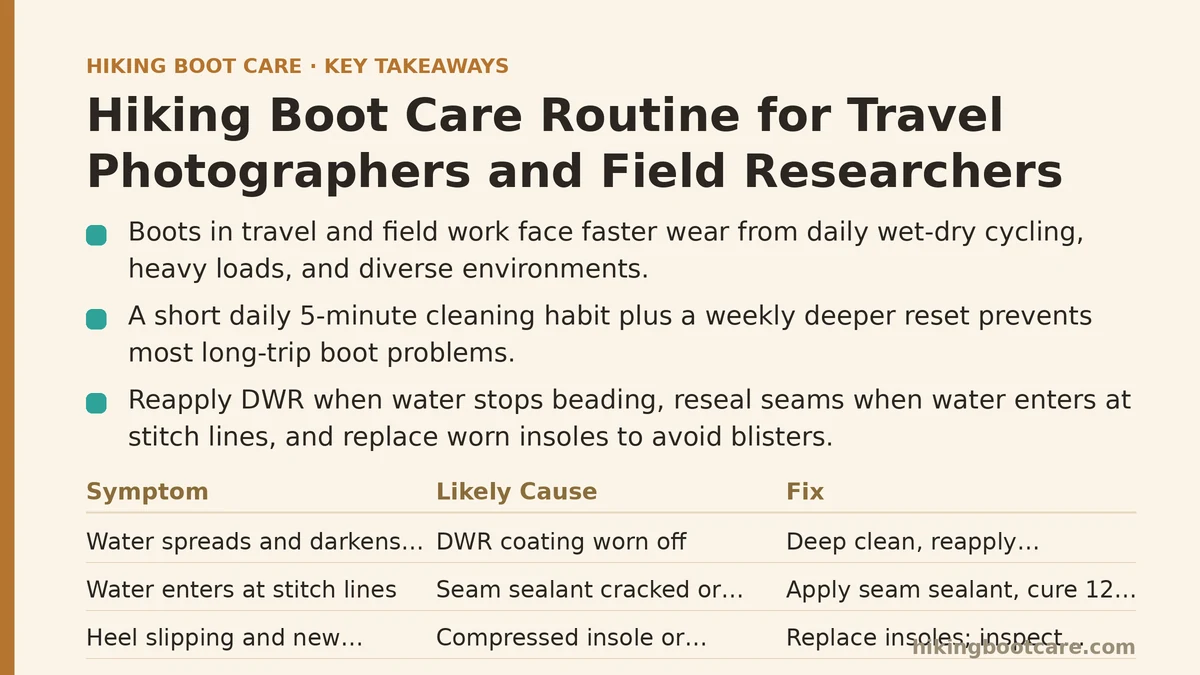
A travel photographer and a day hiker both wear hiking boots, but they ask different things of them. The day hiker’s boot dries out in a closet between Saturday outings. The photographer’s or researcher’s boot might spend six weeks straight on a vehicle floor, in a wet tent vestibule, on salt flats, and on riverbanks — and the care routine that works for the first case often fails in the second.
That gap matters because replacement costs are real: a solid pair of waterproof boots commonly runs $180–$320, and a mid-trip failure can end a shoot or a survey window. Below is a symptom-first routine built around how boots behave when they are worn hard and cleaned rarely, with concrete schedules and fixes you can apply from a hotel room or a field station.
The core difference: cumulative exposure, not trip count
Boots fail from accumulated exposure, and travel/field work stacks exposure faster than recreational hiking:
- Wet-dry cycling: A weekend hiker might soak and dry boots twice a month. On a field rotation, that can happen twice a day.
- Loading: Camera packs and survey gear commonly add 15–25 kg, which concentrates wear at the rand, heel counter, and flex point.
- Environmental variety: Salt, dust, mud, and UV each attack a different part of the boot. A single trip can deliver all four.
- Storage conditions: Boots left in a hot vehicle or a damp tent for weeks age dramatically faster than boots stored dry at room temperature.
The practical takeaway: for this use case, care is a short daily habit plus a deeper weekly reset, not a once-a-season project.
Symptom → cause → fix: a troubleshooting table
Use this as your diagnostic reference when something feels off. Each row pairs a visible symptom with the likely cause and the corrective action.
| Symptom | Likely cause | Fix |
|---|---|---|
| Water spreads and darkens the fabric instead of beading | DWR coating worn off (wetting out) | Deep clean, reapply spray-on DWR while damp, heat-set at low temperature |
| Toe box fabric stays soaked for hours | Saturated outer layer pressing on the membrane; blocked breathability | Clean, dry fully, re-treat; check for mud packed into seams |
| Water enters at stitch lines | Factory seam sealant cracked or worn | Clean and dry, apply seam sealant to stitching inside and out, cure 12 hours |
| Soles feel stiff and “dead” | Midsole foam compressed or degraded by heat exposure | Acceptable wear on old boots; avoid storing in hot vehicles to prevent it |
| Sole peeling at toe or heel | Adhesive failure, often from prolonged damp storage | Clean both surfaces, use boot-repair adhesive for minor lifts; retire if widespread |
| Persistent musty smell inside | Mildew from boots stored damp | Baking soda overnight, fully dry with insoles and laces removed, air out |
| Heel slipping and new blisters | Compressed insole or collapsed lining | Replace insoles; inspect interior seams for bunched lining |
| Laces fraying or snapping | Abrasion and UV degradation | Replace with flat braided polyester laces; carry a spare pair |
| Leather cracking at flex points | Oils leached out; no conditioning | Clean, condition with leather conditioner, then waterproof a day later |
The daily 5-minute field routine
This is the habit that prevents most long-trip problems. It requires no products beyond a cloth and a brush.
- Knock off grit before you go indoors. Mud and sand trapped in the lugs and rand abrade the boot from the inside out as you walk.
- Remove insoles and loosen laces. Air needs to move through the boot, not around it.
- Wipe the exterior with a damp cloth. Focus on the rand line, seam lines, and the tongue folds where grime collects.
- Dry at ambient temperature, never on a heat source. Radiators, campfires, and car heaters above roughly 40°C can soften adhesives and warp midsoles.
- Stuff with newspaper or a dry cloth if the interior is damp. Change the stuffing once before bed if it comes out wet.
If boots are wet through, plan on 8–12 hours of air drying. A fan moving room-temperature air across them cuts that time meaningfully; direct heat does not.
The weekly reset: what to do when you have a rest day
Once a week on a long trip — or every 2–3 outings on a shorter one — do a fuller pass:
- Deep clean. Lukewarm water around 30°C with a pH-neutral footwear cleaner and a soft brush. Never dish soap or laundry detergent; residues left behind repel treatments.
- Bead test. Run water over the toe box and side panels. Round droplets that roll off mean the DWR is intact. Spreading and darkening means it has failed.
- Re-treat if needed. Spray-on DWR for synthetic and textile boots, wax for full-grain leather. Apply while the boot is slightly damp so fibers absorb the treatment.
- Heat-set the treatment. Low tumble dryer heat (no higher than 40°C, 20–30 minutes) or a hairdryer held 10–15 cm away on medium, moving continuously. Skipping this step is the most common reason re-treatments fail within days.
- Condition leather. A dedicated leather conditioner restores oils; apply waterproofing a day later, not in the same session.
- Inspect seams and laces. A bright light and two minutes of looking prevents most on-trail surprises.
Packing and storage: the part most travelers get wrong
Boots that sit damp in a vehicle or duffel for days between shoots degrade faster than boots you are wearing. Three rules cover most situations:
- Travel with boots dry. If you must pack them damp, remove insoles and laces, stuff with newspaper, and unpack at the first opportunity.
- Never store in a hot vehicle. Sustained heat above roughly 40°C accelerates adhesive failure and midsole breakdown. A shaded footwell is still a hot footwell.
- Pack a minimal care kit. A soft brush, a small bottle of pH-neutral cleaner, a DWR spray or wax appropriate to your boot material, seam sealant, and a spare set of laces covers nearly every field scenario and weighs under 500 g.
Material-specific decisions: if X, then Y
- If your boots are full-grain leather: condition monthly on long trips; wax-based waterproofing; expect leather to darken slightly.
- If your boots are nubuck or suede: never use wax or oil-based products; use a conditioning spray formulated for nubuck and suede; expect texture changes from heavy products to be permanent.
- If your boots are synthetic or textile with a membrane: spray-on DWR, heat-set every time, and check seam sealant more often than leather-boot owners do.
- If your boots are combination builds: treat leather panels and fabric panels separately; one product rarely serves both well.
- If you work in salt or coastal environments: rinse with fresh water at the end of each day — salt is hygroscopic and pulls moisture into materials overnight.
Common mistakes and how to recover
- Treating dirty boots. The treatment bonds to grime, not fibers, and fails within days. Recovery: deep clean and re-treat.
- Skipping heat activation. DWR stays soft and rubs off. Recovery: reapply and heat-set correctly.
- Using dish soap. It strips DWR and leaves residues. Recovery: rinse thoroughly, let dry, re-treat.
- Drying on a radiator or fire. Heat damage to adhesives and foam is permanent. Recovery: none for structural damage; prevent it next time.
- Assuming a membrane means waterproof. Membranes are waterproof; the outer layer and seams are what fail first. Recovery: address the DWR and seams, not the membrane.
- Ignoring insoles. Compressed insoles cause blisters and instability. Recovery: replace every 500–800 km of loaded walking, sooner if the foam no longer springs back.
What to do next
- Today: run the bead test on your current boots. If water spreads rather than beads, schedule a clean-and-treat session before your next trip.
- This week: assemble the minimal field kit — brush, cleaner, DWR or wax matched to your boot material, seam sealant, spare laces.
- Before your next departure: clean, re-treat, heat-set, and inspect seams and laces. Note the date so you can track your re-treatment interval.
- On the road: adopt the 5-minute daily routine and the weekly reset. A rest day is the right time to use it.
A routine this small is the difference between boots that last several seasons of hard field use and boots that fail in the middle of a shoot. The daily habit carries most of the weight; the weekly reset catches what the daily habit misses.
Have a boot material, environment, or failure mode you’re unsure how to handle? Describe it in the comments and you’ll get guidance based on how these materials and constructions commonly behave in the field.
Related guides: How to Waterproof Your Hiking Boots at Home: What Works, Your Pre-Season Hiking Boot Maintenance Checklist: What Experts Do, and Common Hiking Boot Care Mistakes to Avoid (According to What Fails).