By the end of this guide, you will be able to look at a worn pair of hiking boots and make a confident, cost-based decision: pay for a resole, or put the money toward a new pair. That decision comes down to four variables — the condition of the upper, the type of sole construction, the quoted repair price, and how much life the rest of the boot has left. This guide walks through each one, with typical price ranges and clear decision branches.
What does a resole typically cost, and what does a new pair cost?
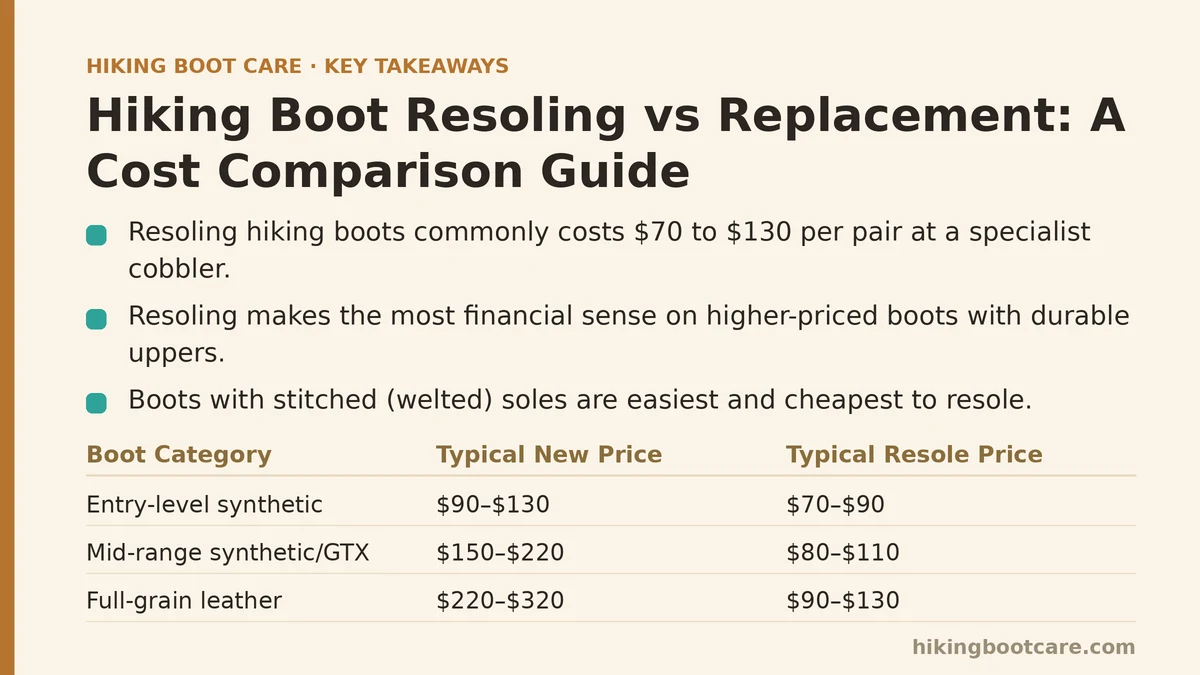
Resoling a hiking boot commonly runs between $70 and $130 per pair at a specialist cobbler, depending on the sole unit and whether the midsole is replaced at the same time. A full-grain leather boot with a stitched sole sits at the lower end; a boot that needs a new midsole plus a new outsole, or a model with a proprietary sole system, sits at the upper end.
New hiking boots, by comparison, commonly fall into these bands:
| Boot Category | Typical New Price | Typical Resole Price | Resole as % of New |
|---|---|---|---|
| Entry-level synthetic | $90–$130 | $70–$90 | 60–80% |
| Mid-range synthetic/GTX | $150–$220 | $80–$110 | 40–65% |
| Full-grain leather | $220–$320 | $90–$130 | 30–50% |
| Premium leather (stitched) | $300–$420 | $110–$130 | 28–40% |
The pattern is clear: resoling makes the most financial sense on higher-priced boots with durable uppers. On a $110 synthetic boot, a $90 resole is poor value because the upper is unlikely to outlast a second sole.
Which boots can be resoled at all?
Not every boot is a resole candidate. Construction determines this before cost even enters the picture.
- Stitched (welted) construction: The outsole is attached with stitches as well as adhesive. These are the easiest and cheapest to resole, and the repair is highly reliable. Common on traditional leather hiking boots.
- Cemented construction: The sole is glued only. Resoling is possible but requires a cobbler experienced with hiking boots; the bond quality depends heavily on surface preparation. Most modern synthetic boots use this method.
- Injection-molded / proprietary systems: Some manufacturers bond the sole in ways that make third-party resoling difficult or impossible. In these cases, the maker’s own repair service may be the only option — or replacement is the realistic path.
- Molded-on soles with integrated midsoles: If the midsole foam is bonded to the outsole as one unit, a resole means replacing both. Expect the higher end of the price range.
Quick check: Look at the rand (the rubber strip around the base) and the seam where the upper meets the sole. Visible stitching along that seam usually signals a boot that is straightforward to resole.
When is resoling the better choice?
Resole when the upper is structurally sound and the wear is confined to the outsole and midsole. Run through this checklist:
- The leather or textile upper has no deep cracks, tears, or delamination.
- The rand is intact or only lightly scuffed.
- The waterproof membrane (if present) has not failed — a leaking boot with a dead membrane is a poor resole candidate, because the repair will not fix the leak.
- The lining is not worn through at the heel or collar.
- The boot still fits well and the footbed has not collapsed.
If all five pass, a resole at $80–$130 can add roughly another full sole-life of use — commonly two to four years of regular hiking — for a fraction of a new pair. This is the strongest case for repair.
When is replacement the better choice?
Replace when the cost of the resole approaches the value left in the rest of the boot. Common signals:
- The upper is failing. Cracks across the flex point of the toe box, a peeling rand, or delaminating leather cannot be fixed by a new sole.
- The membrane has failed. If water gets in through the upper regardless of DWR treatment, a resole will not restore waterproofing.
- The resole quote exceeds about 50% of a comparable new boot’s price. At that ratio, the money buys more certainty when put toward a new pair.
- The boot is a cemented synthetic model near the end of its upper’s lifespan. The math rarely works in favor of repair here.
- Fit has degraded. A compressed, packed-out boot no longer supports the foot the way a new one will.
How long does a resole take, and what is the hidden cost?
Turnaround at a specialist cobbler typically runs one to three weeks, longer in peak season. That downtime is a real cost if you hike weekly — you either go without boots or maintain a spare pair. Factor in shipping if you use a mail-in service, commonly $15–$30 each way.
Beyond the invoice, weigh these against replacement:
- Resole: lower cash outlay, keeps a broken-in upper that already fits your foot, but incurs downtime and depends on cobbler skill.
- Replacement: higher cash outlay, immediate availability, fresh membrane and midsole cushioning, but you re-break-in the boot and discard a possibly good upper.
What are the common mistakes in this decision?
- Resoling a boot with a dead midsole. If the foam midsole is compressed and brittle, insist the quote includes midsole replacement. A new outsole on a collapsed midsole feels flat and wears unevenly.
- Ignoring membrane condition. Test waterproofing before committing to a resole. If the boot wets out through the upper, the repair money is wasted.
- Choosing the cheapest cobbler. A poorly bonded sole can delaminate within a season. Ask specifically whether the shop has experience with hiking boot construction.
- Waiting too long. Once the outsole wears through to the midsole, trail debris and moisture damage the midsole, raising the repair cost or killing the resole option entirely.
- Skipping the manufacturer’s repair program. Some brands offer factory resoling or repair at a set price; it is worth a quick check before assuming a third-party cobbler is the only route.
How do you decide today?
Work through this sequence in order:
- Inspect the upper. Any cracks, tears, or delamination? If yes, replace. If no, continue.
- Test waterproofing. Run water over the boot. If it wets out through the fabric or leather after proper treatment, replace. If it beads, continue.
- Confirm the construction. Stitched or cemented with a repairable sole? If injection-molded and proprietary, check the maker’s repair service first.
- Get a quote. Compare it to a new pair of the same category using the percentage table above. Below roughly 50% of new price with a sound upper — resole. Above it — replace.
- Account for time. If you cannot go one to three weeks without the boots, weigh that against the savings.
If the boot passes steps 1 through 3 and the quote lands in the favorable range, book the resole and ask explicitly about midsole replacement. If it fails any earlier step, put the repair budget toward a new pair and keep the old boots as a backup or for yard work.
Not sure whether your specific boot is a resole candidate? Describe the upper’s condition and the sole construction in the comments for a take based on how each type commonly holds up. Related guides: How to Waterproof Your Hiking Boots at Home: What Works, Your Pre-Season Hiking Boot Maintenance Checklist: What Experts Do, and Common Hiking Boot Care Mistakes to Avoid (According to What Fails).